Claude Cowork Use Cases That Will Save You 2 Hours Of Work Everyday
AI agents used to need engineers. Now anyone can build one just by talking to Claude Cowork.

Mark Treepetchkla

For all of 2025, the phrase "AI agents are coming" echoed through every conference keynote, every podcast, every breathless LinkedIn post. It became background noise. The kind of prediction that sounds inevitable but never quite shows up at your desk on a Monday morning. Then I downloaded Claude Cowork, pointed it at my chaotic Canva workspace, and watched it do something no AI tool had done for me before.
It didn't give me suggestions. It made a plan, asked for my permission, and then reorganized the entire workspace on its own. That was the moment "AI agent" stopped being a prediction and became something I could point at on my screen.
Evolution of AI Agents from 2025 to Present
The difference between what I experienced and what AI chatbots have been doing for years comes down to one thing: execution. Before Cowork, AI was a suggestion engine. You asked it a question, it gave you an answer, and then you went and did the work yourself. Cowork crosses that line. It connects to your actual tools, plans multi-step workflows, and carries them out.
I connected Gmail, Notion, Slack, Canva, Google Sheets, and HubSpot. Once those connectors were in place, Cowork could read from and write to each of those apps directly. It didn't tell me what to post in Slack. It posted it. It didn't recommend how to reorganize my files. It reorganized them.
And the part that matters most: none of this required writing a single line of code. You download the Claude desktop app, switch to the Cowork tab, connect your tools through a login flow that feels like signing into Google, and start prompting. That's the setup.
One practical note: Cowork is only available on paid plans, and I'd recommend using the Sonnet 4.6 model. Agent workflows burn through credits faster than regular chat, so Sonnet gives you the best balance of intelligence and efficiency.
How Claude Cowork Works
The feature that separates Cowork from anything else I've used is Skills. Think of it like onboarding a new hire. You have a conversation with Cowork about what you need, and it builds a repeatable capability from that.
I built a research assistant skill that follows my own method for investigating topics. I made a presentation structure skill that lays out slides the way I like them. I even created one for designing thumbnails on Canva. Each skill took a conversation to set up, not a technical build. What you teach it is entirely up to you.
Claude also provides pre-built skills and Plugins that bundle capabilities for specific domains like Sales, Finance, and Enterprise Search. Browse the marketplace, install what fits your work, and Cowork gets sharper at the things you actually need it to do.
The barrier to creating your own AI agent is knowing how to explain your workflow out loud. A marketing lead can build a skill for writing campaign briefs. A finance manager can build one for reconciling monthly reports. No configuration files. Just conversation.
Three Claude Cowork Use Cases Across Productivity, Creativity, and Analytics
I put Cowork through three types of work to see how far the agent model stretches: productivity, creativity, and analytics.
Productivity was the clearest win. I tested Slack updates, the kind of weekly reporting where you gather context, write a structured message, and post it. I gave Cowork two YouTube links from our February content releases, pointed it to our Slack channel, and asked it to read my previous updates to understand my style. It matched my tone, drafted the update, and posted it. The whole loop took a couple of minutes.
There's also a scheduling feature. You can set prompts to trigger at specific times, so your teams submit reports by 3 PM and Cowork synthesizes everything into an executive summary at 3:30. No bottleneck.
Creativity was more nuanced. I asked Cowork to design a YouTube thumbnail on Canva. Our thumbnails are multi-element compositions, not single AI-generated images. Cowork used its Computer Use capability to open Chrome, navigate to Canva, and build the thumbnail element by element, clicking through the interface the way a person would.
The result wasn't perfect. Humans still craft better visuals when the work demands precise aesthetic judgment. But for ideation, for roughing out a direction before you refine it, Cowork earns its place. I also had it research AI video editing tools and build a pitch deck. Not conference-ready, but good enough for internal presentations or getting a draft to 60% before you polish it yourself.
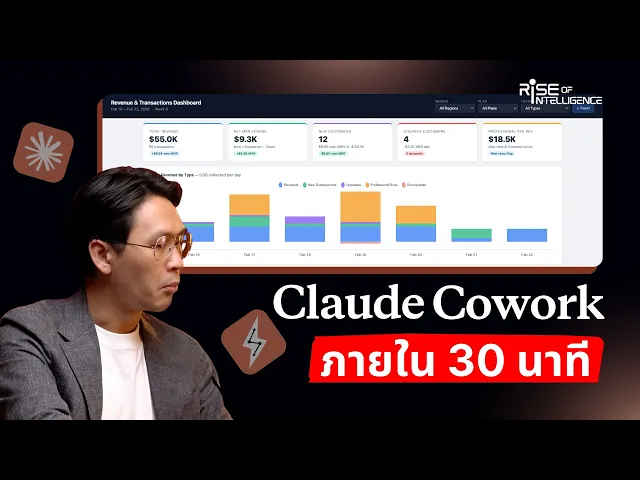
Analytics impressed me the most. I set up a scenario as a sales manager reviewing February performance across B2C and B2B. Cowork pulled data from Google Sheets and HubSpot, analyzed the trends, and flagged that February was heading downward. I asked it to revise the Q2 forecast with adjusted assumptions, and it recalculated every projection in the sheet. The kind of work that eats a sales manager's entire afternoon happened while I watched.
None of these are developer use cases. These are the tasks that marketing managers, sales leads, and small business owners face every week. McKinsey found that companies implementing these technologies see revenue increases of 3% to 15%, alongside a 10% to 20% improvement in sales ROI.
Claude Cowork Is Taking Over Back Office Tasks
Here's where the implications get bigger than one person's productivity. What I just described across those three tests is one person automating tasks that used to require dedicated roles. A file manager. A report writer. A sales analyst.
Scale that pattern across a company and the back office starts to thin out. Wall Street banks are already planning to cut roughly 200,000 back-office positions over the next three to five years. Globally, an estimated 85 million jobs will be displaced by AI and automation by the end of 2026.
Companies that move on this first will become leaner. Leaner companies price more aggressively. More aggressive pricing means cheaper products for consumers. The cost structure gap between companies using agents and companies staffing every function manually will only widen.
But the real story isn't about cutting headcount. It's about who gets to build a business in the first place. When AI handles the operational overhead that used to require a team of five, a founder with one person and a handful of well-trained agents can compete with companies ten times their size. Small business AI adoption jumped 41% in 2025 alone, and the gap between small and large business adoption is narrowing fast.
A two-person company in Bangkok or Lagos or Medellín can now operate with the back-office capability of a fifty-person firm in San Francisco. That's what democratization actually looks like. Not everyone getting access to a chatbot, but everyone getting access to a workforce.
Agent Is Moving From Tool to Teammate
Building an AI employee is no longer a fictional concept. It exists today inside a desktop app that costs less than a Netflix subscription, and it is getting better with every model update.
What Cowork shows right now is version one of something that will evolve into fully autonomous teammates. Not tools you prompt, but colleagues you work alongside. Agents that anticipate what needs doing, coordinate with other agents, and own entire workflows from start to finish.
The trajectory is visible if you look at where we were just two years ago: from chatbot, to assistant, to agent, to colleague. We're at the agent stage now. The colleague stage is closer than most people think.
For all of 2025, the phrase "AI agents are coming" echoed through every conference keynote, every podcast, every breathless LinkedIn post. It became background noise. The kind of prediction that sounds inevitable but never quite shows up at your desk on a Monday morning. Then I downloaded Claude Cowork, pointed it at my chaotic Canva workspace, and watched it do something no AI tool had done for me before.
About
Featured Posts

Related Post
Consumers don't click links anymore. They ask AI. But does AI mention your brand?